

Nika’s story
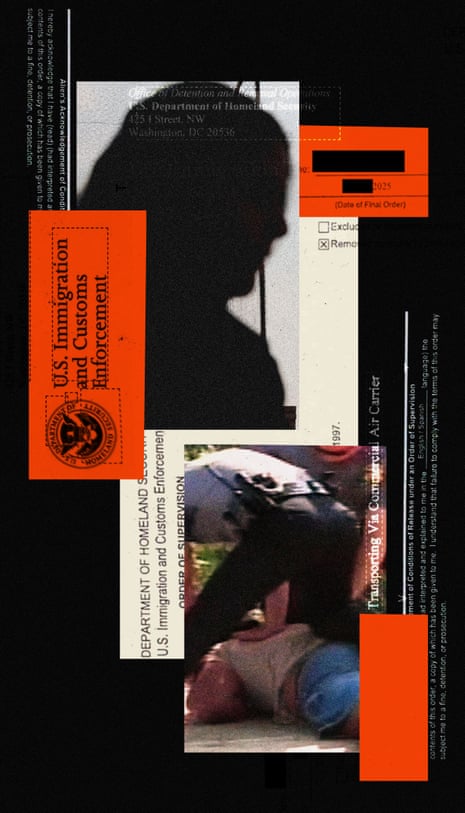
No one would tell the shackled detainees onboard the US immigration plane where they were going. The officers in charge would taunt them when they asked, they said. It was only when the seat-back video screens finally showed a map that the 18 migrants worked it out.
Their destination was Central African Republic (CAR), a country few of them had even heard of.
Nika, a 32-year-old Iranian woman, recalled how the handcuffs dug into her wrists. She begged the officers to loosen them, but they did not. Other passengers had it worse, she said. Some of the men were restrained in black and yellow body wraps, as if mummified, after resisting orders to get on the plane.
Nika, who had fled Iran 18 months earlier after protesting against its regime, had imagined the US as a place of sanctuary. Iran was already one of the most repressive countries in the world when she left, and its horrors had only deepened since then: security forces gunned down thousands of other demonstrators this year, then Donald Trump’s administration launched the war there.
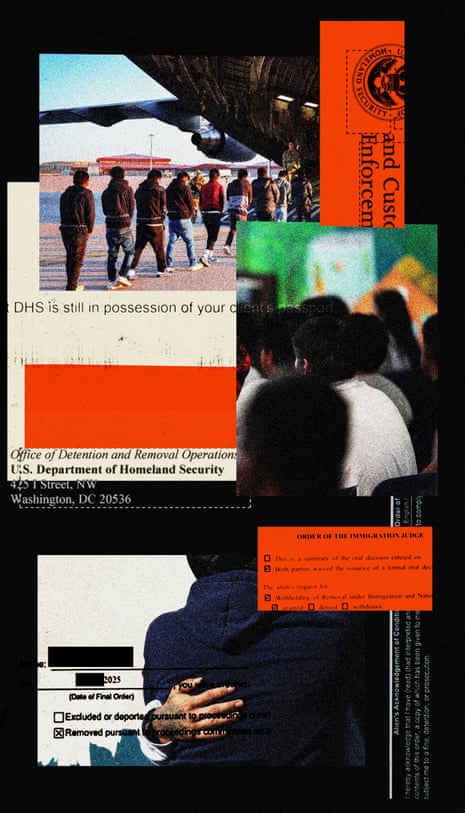
After more than a year locked up in a US immigration detention centre, Nika, whose name the Guardian has changed to protect her family in Iran, was granted legal protections and freed on a judge’s orders. Within two weeks, the Department of Homeland Security had rearrested her, and days later she was on the plane heading 7,000 miles east.
“They never told me they were going to deport me [to] this country,” she told the Guardian. “I don’t know anything about Africa.”
The Department of State warns US citizens not to travel to CAR because it says it is too dangerous. Nika spends most of her days there under a form of self-imprisonment, too scared to venture out from her small bedroom as she waits for an answer to the question on which her life depends: will she be sent back to Iran, and to a regime that could kill her?
Nika is one of more than 25,000 people deported by the Trump administration to countries that are not their own. About 20,000 people have been bussed to Mexico, according to a count by Refugees International and Human Rights First. And more than 5,000 others have been put on flights to countries in Africa, Latin America, the Caribbean and central Asia to which they have no connection, and then, often, returned to the countries where US immigration judges had ruled their lives or liberty were at risk.
Human rights lawyers describe these so-called third-country national arrangements as part of a “show of force” by the US intended to discourage migrants and asylum seekers from entering. People from Peru and Colombia have been sent to the Democratic Republic of the Congo (DRC). On 20 August, four Cubans, a Brazilian and a Cameroonian refused to disembark in Liberia, and were sent to Equatorial Guinea instead.
In order to compile the most comprehensive account of a policy that has mostly operated behind closed doors, the Guardian joined 23 other media organisations in the Deportation Project, a joint investigation coordinated by Paris-based Forbidden Stories. The consortium interviewed more than 100 people affected by, or involved in, the US drive to extinguish unauthorised immigration, and reviewed documents outlining details of the agreements made by US officials with governments around the world.
It has tracked more than 100 flights that have carried migrants and asylum seekers to 28 different countries. This is likely to be an undercount as the consortium’s dataset only includes flights it was able to independently verify.
The pace of flights is increasing. After an initial wave during the opening months of the second Trump administration, the number of deportations spiked in August again when, according to a count by Human Rights First, a record 16 flights carried people to 13 different countries that were not their own.
A US federal appeals court ruled on Friday that third-country removals were unlawful, arguing that they violated due process because people are not notified with enough time to mount a legal challenge to the decision to send them to another country. Human rights lawyers suggested this should immediately ground third-country deportation flights. The government is expected to appeal against the judgment, and to press ahead with its policy.
A state department spokesperson said implementing the Trump administration’s immigration policies was a “top priority” and “we are unwavering in our commitment to end illegal and mass immigration and bolster America’s border security”. They added: “The US government will use all legal means to remove those with no right to remain in our country.”
The Trump administration has said the people it deports are criminals. Yet documents obtained by the Washington Post as part of this project show that a majority of the 35 countries that have signed deals with the US have said they will not accept migrants with violent criminal records.
The people forced on to planes include those who spent most of their lives in the US, parents detained on the school run, the adult children of elderly relatives who depend on them for care.
Many are people whose fear of returning home was deemed so credible that immigration judges barred their removal from the US. Nika had been granted “withholding of removal”, a protection for individuals who may face severe harm in their country of origin but are ineligible for asylum. On 28 May, not only was she released from US Immigration and Customs Enforcement’s custody, but she was eligible to find a job, to work, and to stay.
Image credit: Guardian Design/Getty Images/Reuters
The rug pull

Nika’s lawyer, Sahar Jalili, is Iranian and, like her client, studied in Tehran. She took the case when she was pregnant, and often worked past the point of exhaustion. “That could be me,” she said of Nika.
Combing through the case file, Jalili was shocked to learn ICE had officially decided to send Nika to CAR’s capital, Bangui, just eight days before a judge ordered her release from the detention centre. Her uncle’s family had prepared a room for her in Los Angeles. It took her two days to get there, and she spent a week with them, unfurling, after 18 months of hell.
Her re-arrest on 8 June, during what ICE officers had presented as a routine check-in, felt like cruelty for cruelty’s sake, Jalili said.
Nika said she had finished her appointment and left when an officer called her uncle and asked him to drive her back to pick up some papers.
This time there were new questions. A man took Nika’s fingerprints, then her photograph, Jalili said. “Then he came back accompanied by a female ICE officer, and they said put your hands above your head.” She said she was arrested, handcuffed and led to the basement.
Nika felt numb, she said, as she was transferred out of the detention facility that evening. Anti-ICE demonstrators smacked their palms on the side of the van as she passed through protests that had become a regular feature in LA.
For Jalili, the previous two days had already been a blur, as she and her colleagues battled to save two other Iranian women from being put on the same plane for Bangui. The lawyers managed to get the other two women off the plane, but not Nika. The only difference between them was that Nika was detained last, so by the time a network of immigration lawyers had learned of her case, there was not enough time before the flight departed.
Jalili said she begged every ICE officer: “Give me two days. Just two days.” She recalled: “They told me that they had respected the judge’s order to release her. But they’d never promised not to send her to a third country.”
Image credit: Guardian Design/AP/Reuters
African deals
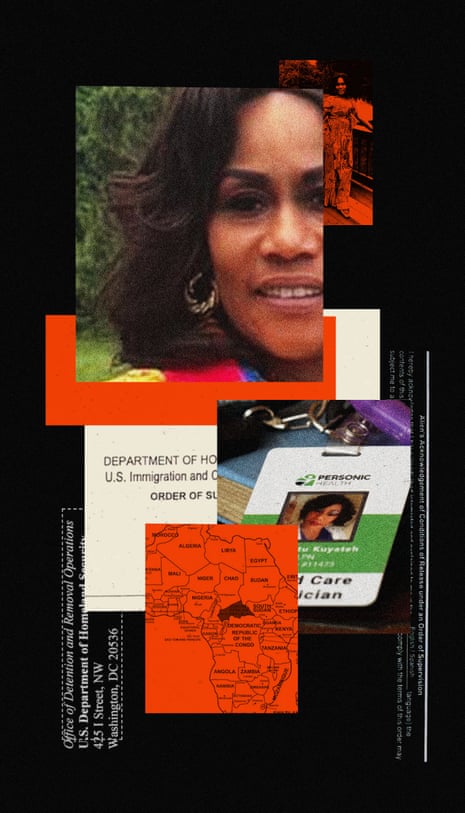
When Rabbiatu Kuyateh, 58, learned that the country she had been sent to, Ghana, was deporting her to her childhood homeland, she was so scared it took a scrum of people to force her into the waiting van.
A video captured the moment last November when she was dragged, shoeless and distraught, by her hair. She still remembers the crack of her head on the stone steps as she begged not to be returned to Sierra Leone, screaming: “I’m not going.”
Kuyateh was a nurse and had spent most of her life in the US with her parents, after fleeing Sierra Leone. She cared for American coronavirus patients during the pandemic and had looked after disabled adults and children in the years since.
She had scrapped hard for the life she built, she said. She had raised her son, Mohamed, alone and they had bought a house together. By the time Trump was re-elected in 2024, her parents were so frail she began each day by checking on them before her shift, and then returning to make sure they were ready for bed.
In order to accelerate its expulsion of people such as Kuyateh, the Trump administration has remade the very institutions that were once intended to protect migrants who fled persecution.
“I would describe [this] as the Trump administration’s way of trying to undermine the concept of asylum and refugee protection,” said Alma David, one of the leading immigration lawyers tracking the policy. “While the US understands that they can’t deport them to their home country legally, what they can do is basically send them through this third country that perceives itself as a transit hub.”
The drive is being led by Stephen Miller, the White House deputy chief of staff, who has been open about his desire to end most migration to the US. In interviews with the Washington Post as part of the Deportation Project, current and former US officials said Miller had rolled out the third-country removals policy by pushing key appointments inside the state department that have allowed him to overrule other foreign policy objectives in service of his agenda.
Among them is Christian Ehrhardt, a career state department official who heads the newly formed Office of Remigration – its name incorporating a term adopted by the far right to describe the forcible expulsion of minority ethnic immigrants. Ehrhardt has helped secure at least 13 third-country deportation agreements in Africa, after diplomatic tours through the continent.
Internal records reviewed by the Washington Post show the Trump administration has pledged at least $410m (£307m) to secure such agreements with 35 different countries, almost a third of them in Africa.
They indicate that $30m was earmarked for Cameroon, in order to support UN operations in the country, in return for accepting 1,000 migrants. The US has so far sent only 44. The DRC was promised $75m towards UN operations there, in return for accepting 2,000 migrants. It has only received 15, and flights to Kinshasa are on hold due to the country’s Ebola outbreak.
The arrangements differ from country to country. A handful, including Eswatini, have agreed to accept people with violent criminal histories. But many have said they will not take anyone with a record of violence or other types of serious crimes. The state department did not respond to questions about details of these agreements.
Ghana will only take people from west Africa; CAR did not specify nationalities, and the passengers on Nika’s plane were from places including Afghanistan, Iraq and Kyrgyzstan. Most of them had no ties to Africa at all, she said.
On 1 July 2025, Kuyateh’s son, Mohamed, had accompanied her to a routine ICE check-in, as her immigration status required. He remembered his mother feeling anxious that the cuffs on an officer’s belt were for her. “I doubt it,” Mohamed told her. But when they called Kuyateh into an interrogation room, he was told to wait outside.
“That’s the last time I saw her,” he said.
During Kuyateh’s four months in ICE custody, Mohamed spoke to her often. He had not heard from her on the day in November when he said he was called by another detainee who told him she had been sent to Texas. “And I was just like, why is she going to Texas?”
Two days later Kuyateh called him in tears. She was in Ghana, about to be sent to Sierra Leone.
The footage of her being dragged into a bus, beginning the onward deportation, appeared to anger the Ghanaian authorities when it spread across social media, according to Malick, the Senegalese man, also deported from the US, who filmed it. The Guardian has given him a pseudonym out of concern for his safety. “They got angry,” Malick said. “They came in the evening, at night, with two trucks full of soldiers.”
He said the troops drove his group to a remote military camp with faltering electricity and little contact with the outside world. The Ghanaian government did not respond to questions from the Guardian.
One woman sent to the camp said she grew so scared of what might happen if she was returned to her native Senegal that she attempted suicide by drinking bleach. She was treated in hospital, then sent back to Senegal anyway. “I drank the bleach because I wanted to die,” she said. “Because they wanted to force me to go back to my country.”
Image credit: Guardian Design/Rabbiatu Kuyateh
Malaria
Onboard Nika’s flight on 11 June this year, the inflight video showed Ghana as its initial destination, so the passengers assumed that was where they were going. But their stop in the capital, Accra, was brief. The 18 passengers then landed in Bangui at 9.45pm, flight monitors said. The officers onboard removed their cuffs, but did not get off the plane.
For several hours, the group did not meet anyone who spoke English. “They were communicating with hand gestures, like, get on a bus, and then they put us on a bus. And then they took us to give us some vaccinations, and I didn’t know what they were going to inject me with,” Nika said. It turned out to be for yellow fever.
Her room was in an apartment block. She was told she could stay for three months. But the idea of returning to Iran was unfathomable.
US-based Iranian rights groups say they have been unable to determine the fates of hundreds of other Iranian nationals deported back home during the course of the US-Israeli war on Iran. A recent lawsuit filed against ICE alleges the administration has shared the records of Iranian asylum-seekers with the very regime they had fled, further elevating the risk for those sent back.
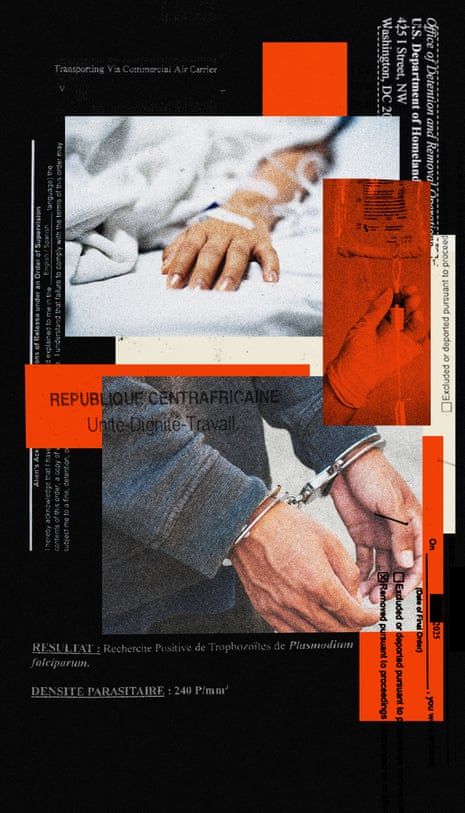
When a headache started clouding her brain, Nika thought it was a migraine. She felt sick, her body hurt. She had been bitten by so many mosquitoes that her skin looked bruised, she said. A medical report, seen by the Guardian, confirmed she had malaria. Speaking by phone, Nika said: “I didn’t even know what that was.”
Back in Los Angeles, Jalili waited anxiously on updates about Nika’s situation. There were injections every 12 hours to clear her bloodstream of parasites. The bad news did not stop when she was well enough to return to her accommodation. Jalili was horrified to learn Nika had been deported from the US without her passport, meaning she had neither identification documents, nor a visa, and on trips to the hospital and vegetable market, police officers used her lack of papers to make threats.
The CAR government did not respond to a request for comment.
The second time she was stopped, Nika said, the police officer mimed the action of putting cuffs on her. The message, she said, was: “I can take you in, unless you pay us.”
Image credit: Guardian Design/Getty Images/Reuters

As the Trump administration accelerates its third-country deportations, CAR is one of 13 host countries where the deported are being supported by the International Organization for Migration (IOM), a UN agency, which provides them with food, lodgings and psychological counsel upon their arrival.
Although the Trump administration has announced sweeping cuts to its funding for UN agencies, there seem to be exceptions where the funds enable this deportation programme.
In March last year, the state department spelled out the logic. From now on, it said, humanitarian funding would be used to “reduce mass and illegal immigration, such as funding voluntary returns of illegal aliens, incentivising governments to implement safe third-country agreements, and building the migration management capacity of other countries”.
According to a federal government database that tracks spending, more than 60% of US grants to the IOM during the second Trump administration have gone to programmes in countries that accept deported migrants. In CAR, that meant an allocation of $85m. The highest US contribution to IOM in CAR under the Biden administration, according to the database, was $14m.
Nika said she had been treated well by the agency. “The people here are doing their best,” she said. The accommodation was secure and transport was provided when needed. “But at the same time, it’s not living. I’m breathing here, I’m not dying. But I can’t leave the house without a driver they provide here. I can’t find jobs. I don’t speak their language.”
The potential for a negative perception of its involvement in the programme is something the IOM has grappled with. An internal risk assessment for a programme supporting third-country nationals sent from the US to one African country, seen by the Guardian, warns it could lead the agency to be “perceived as complicit”.
An IOM spokesperson said in a statement that such assessments were conducted in order to ascertain whether host nations were able to commit to safeguards for the migrants, but added: “We are fully cognisant that states use financial assistance to advance their national priorities. However, IOM’s decisions to accept funding, provide post-arrival assistance, or support assisted voluntary return are guided by our own mandate and principles, and rest on a single question: whether our engagement will improve the lives of the migrants affected. In these instances, we believe strongly it does.”
Many in the human rights field are uncomfortable the UN is easing the process for governments that agree to cooperate with the Trump administration.
“It just feels very incongruous for IOM to be the organisation in charge of these men and women,” said Alma David. “These aren’t migrants in your typical sense. These aren’t people who chose to migrate,” she said. “These are people who were kidnapped, essentially.”
Image credit: Guardian Design/Getty Images/Alamy
Life in the shadows
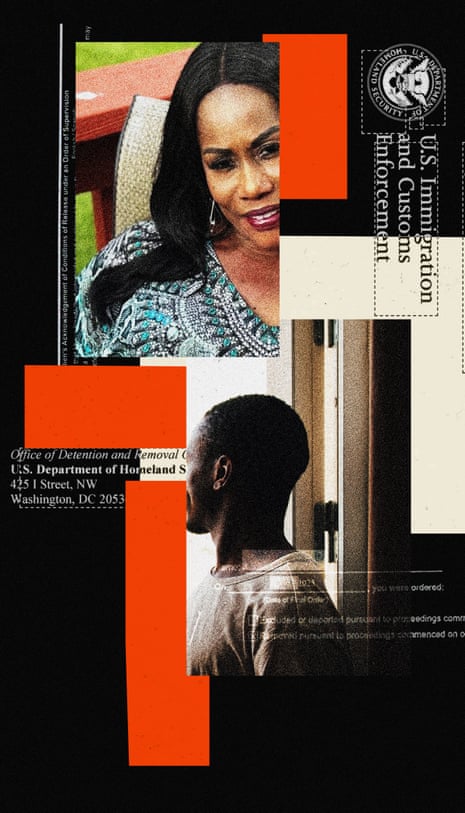
People who had been returned from third countries to the places they were born describe a life now lived in the shadows. Kuyateh left Sierra Leone within days of being sent back there. The Guardian is not naming her location. “I don’t sleep at night,” she said. “Sometimes I just wake up. I’ll be sitting down like, what am I doing here? Why am I here?”
She called her family every day. Sometimes, she said, she felt too sad to turn on the video and see their faces. She could get through the conversation with her mother without tears, she said, “but whenever I talk to my daddy, I’ll be crying. And when I sit here, I think about them. It hurts so much.”
She was not sure what scared her more: the thought of dying alone in a foreign country, or knowing that her parents might die without her at their bedside.
Annan, a gay man who fled Ghana after he was outed, and then hunted, by members of his family, said he was terrified when he touched back down in Accra. He had refused to disembark during his initial deportation from the US to Sierra Leone, and had to be forcibly removed from the plane, he said. He later begged authorities not to return him, he said, but they did not listen.
In a statement, the Sierra Leonean government said it took its “international obligations seriously” but that questions relating to immigration protections afforded by an American court were for the US government to address.
It added: “So far, no individual returned to Sierra Leone under the TCNA [third-country national arrangement] has requested to remain in Sierra Leone or not to be returned to his or her country of choice either in west Africa or beyond.”
Annan’s mother had used her savings to pay for his escape to the US. She was distraught when he called to say he was back. “She knew she couldn’t protect me,” he said.
He shared footage of where he lived now: an abandoned building with no electricity or running water in a neighbouring country, he said. He spent his daylight hours hiding, and walked almost an hour to find food when darkness fell. His bed was a blanket on the floor, although he barely slept, he said, too scared of being infected by one of the insects that crawled or buzzed around him. He said the loneliness felt crippling.
In recent weeks, someone had texted him anonymously, saying that his survival, as a gay man, would not be tolerated. The message made him feel hopeless: he could run, it said, but he could not hide for ever.
Image credit: Guardian Design/Getty Images/Rabbiatu Kuyateh
Exhaustion
In Los Angeles, Jalili is getting more calls about clients bound for deportation flights. In June, a 30-year-old Iranian woman with a blood disorder that made her so weak she needed a walker was told she would be sent to the landlocked south African nation of Eswatini.
Another client was “going crazy”, Jalili said. “They’re coming up with a new country for her every week.”
Immigration lawyers said that while their jobs had always been hard, the scale of the efforts to obstruct those opposing the Trump administration’s drive to quash all types of irregular migration was unprecedented.
When a client is detained, avenues of accountability have largely been shut, including the office of an independent ombudsman for immigration detention, which was responsible for investigating abuses and misconduct.
In court, immigration lawyers can face hostile judges after the Trump administration purged some of those deemed insufficiently loyal to the deportation agenda. Meanwhile, the cost of even filing a case has risen steeply, under the terms of a bill passed through Congress in July last year.
Jalili, like many others, spent much of the first Trump administration mounting legal challenges against a policy of separating children from their parents at the US-Mexico border. Knowing that what would follow might be worse, she decided on the eve of Trump’s re-election to start her own firm to fight the coming storm
It was not uncommon for calls from the desperate families of new ICE detainees to wake her in the night.
One of the biggest challenges, said Erica Reilly, an immigration attorney based in Washington DC, was basic communication with ICE officers.
“You send all these emails to deportation officers, and you’re like: ‘Hi, just following up again on the email I sent you last week, and the week before that, and the week before that, and the week before that, that you haven’t responded to,’” she said. “And they know they don’t have to because there’s no accountability.”
If you don’t already have the Guardian app, download it (iOS/Android) and go to the menu. Select ‘Secure Messaging’.
“,”displayOnSensitive”:true,”emailContact”:”
If you don’t need a high level of security or confidentiality you can email [email protected].
“,”mainTextHeading”:”Secure Messaging in the Guardian app”,”elementId”:”656ec312-95c0-4ae0-8c95-3b1e2a0ff82e”,”title”:”Get in touch”,”endNote”:”
Finally, our guide at theguardian.com/tips lists several ways to contact us securely, and discusses the pros and cons of each.
“,”subtitle”:”Contact our investigations team”,”_type”:”model.dotcomrendering.pageElements.ReporterCalloutBlockElement”,”activeFrom”:1769644800000,”id”:”10d669d8-b414-449c-8a7c-6319cb7b8eb8″,”intro”:”
The best public interest journalism relies on first-hand accounts from people in the know. If you have something to share on this subject, you can contact us confidentially using the following methods:
“,”securedropContact”:”If you can safely use the tor network without being observed or monitored you can send messages and documents to the Guardian via our SecureDrop platform.“}}”>
The worst thing, she said, was the powerlessness. But the cruelty and the lack of access, she had come to believe, “that’s all the point”.
“I think that the administration is doing what they can to get enough people to say, well, the alternative is too scary or too uncertain or too bad. I’ll just leave on my own.”
Getting through the day meant reformulating the wins, Reilly said. “Getting a call back from a deportation officer shouldn’t be a win, but in this environment it is.”
Jalili said she did her best to focus on the battles she could win. When she heard Nika’s flight had left for Bangui, she sank to the floor, called her mother, and began to cry. “It’s not a situation where you can just say: ‘Oh, I did my best.’”
Nika had lost the life she knew in Iran. The US offered little better. Jalili listed the cost.
“Being detained for 17 months. Being released from the federal judge’s order for 10 days. Being stripped away from her uncle’s hands. Being put in a car and then on a flight in shackles, and for 24 hours, sitting on that flight. She must have felt so lonely.”
Image credit: Guardian Design/Alamy/AP/EPA
Additional reporting by Alice Speri